
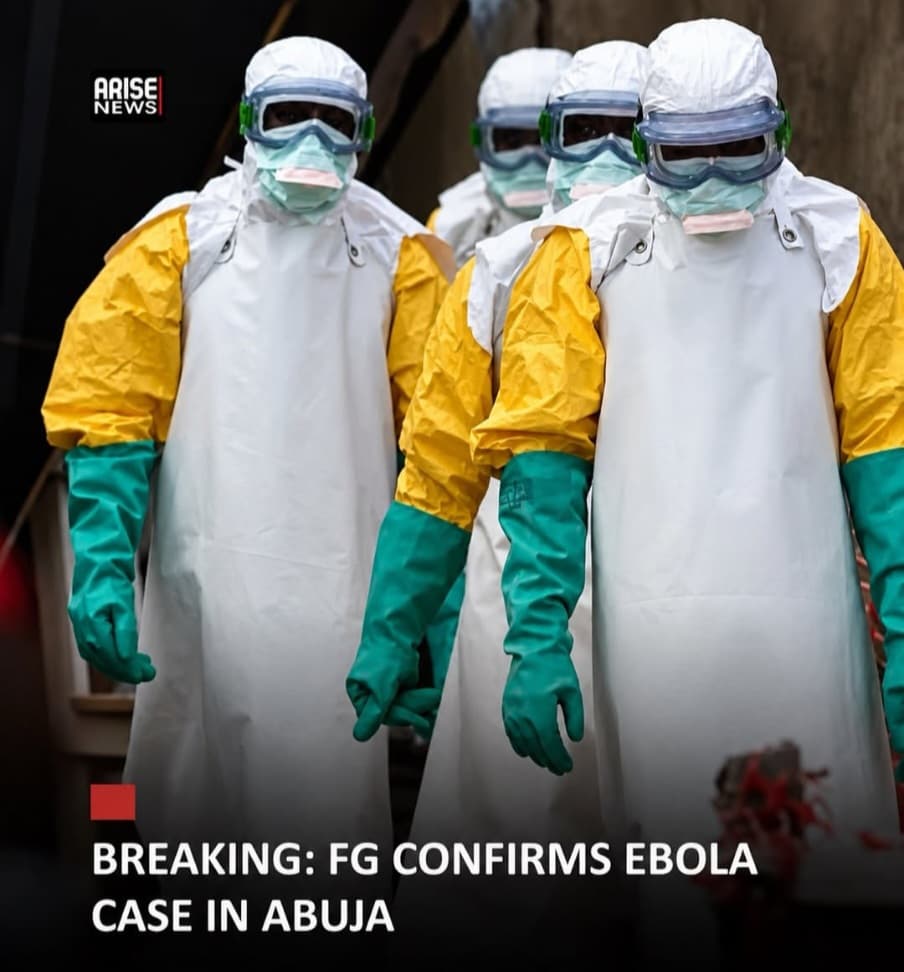
EBOLA IS BACK IN NIGERIA: FROM CONGO TO ABUJA, WHAT MUST WE DO DIFFERENTLY?
By Omolola TalksTV | 20 October 2026
Sometimes, we hear about something happening somewhere else in the world and quietly hope it will never reach our doorstep.
That was exactly how I felt when I first came across reports of the Ebola outbreak in the Democratic Republic of the Congo earlier this year.
I followed the news with concern. I thought about writing something to educate people, especially Nigerians, about the disease and the importance of taking precautions.
But somehow, I kept quiet.
Perhaps I thought it was still far away. Perhaps I believed the health authorities would contain it before it spread beyond the affected communities.
Then came reports from Uganda.
Later, Kenya confirmed cases.
Last week, I found myself thinking about Ebola again. I considered raising awareness through Omolola TalksTV, but I still did not publish anything.
Today, 20 October 2026, Nigeria has confirmed a case in Abuja.
And here I am, writing the article I had been postponing.
Not because I want to frighten anyone, but because I believe information can save lives.
How Did We Get Here?
The Democratic Republic of the Congo is no stranger to Ebola outbreaks.
The country has experienced several outbreaks over the years, including devastating epidemics that claimed thousands of lives.
In September 2025, another outbreak was declared in Kasai Province. That outbreak was brought under control and officially declared over in December 2025.
But in May 2026, a new outbreak emerged in the eastern part of the country, this time involving the Bundibugyo virus, one of the viruses responsible for Ebola disease.
What began in affected communities gradually spread to other areas.
By October, the situation had become deeply troubling, with thousands of confirmed infections and deaths.
Behind those figures are people.
Mothers, fathers, children, healthcare workers, traders, and ordinary families who probably woke up one morning believing they had many more years ahead of them.
Sometimes, we discuss outbreaks as statistics and forget that every number represents someone's loved one.
As the disease spread, cases were also reported beyond Congo, including in Uganda and Kenya.
The movement of people between countries makes it possible for infectious diseases to cross borders, even when the original outbreak begins hundreds or thousands of kilometres away.
And now Nigeria has recorded a confirmed imported case.
What Do We Know About the Abuja Case?
According to the Federal Government, a woman who recently travelled from Uganda tested positive for Ebola after receiving medical attention in Abuja.
She is currently in isolation and receiving treatment.
Health authorities have identified 44 people who may have been exposed and commenced contact tracing.
Let me explain something important here.
Forty-four contacts do not mean forty-four infected people.
It means health officials have identified people who may have had contact with the patient and need to be monitored.
This is exactly why contact tracing is important.
The earlier exposed individuals are identified, the easier it becomes to monitor their health, arrange testing where appropriate, and prevent further transmission.
I sincerely hope the woman receiving treatment recovers fully.
Nobody deserves to become the subject of public ridicule or discrimination simply because they have contracted a disease.
Today, she is someone's daughter, sister, mother, or loved one.
Tomorrow, another family could need the same compassion.
But What Exactly Is Ebola?
Many people have heard the name Ebola, especially those who remember what happened in Nigeria in 2014.
But how many of us truly understand the disease?
Ebola is a serious viral illness that can cause severe sickness and sometimes death.
It can spread from infected animals to humans and then from one person to another through direct contact with infected blood or other bodily fluids.
These include vomit, diarrhoea, urine, and other body secretions.
People may also become infected by touching contaminated materials, including bedding, clothing, or medical equipment, especially when infected fluids enter the body through broken skin or the eyes, nose, or mouth.
Ebola is not spread through ordinary airborne transmission like measles.
It is also important to understand that a person infected with Ebola does not transmit the virus before developing symptoms.
This is why identifying symptoms and possible exposure early is extremely important.
What Are the Symptoms We Should Watch For?
The symptoms of Ebola can resemble those of other illnesses commonly experienced in Nigeria.
Early symptoms may include:
- Sudden fever
- Severe weakness and tiredness
- Headache
- Muscle and joint pain
- Sore throat
- Loss of appetite
As the illness progresses, some patients may experience vomiting, diarrhoea, abdominal pain, and dehydration.
In severe cases, bleeding and organ complications may occur.
But please understand this: not everybody with Ebola will bleed.
Not everybody with fever, vomiting, or diarrhoea has Ebola.
Malaria, typhoid, and other infections can produce similar symptoms.
That is why proper medical assessment and laboratory testing matter.
Symptoms can appear between 2 and 21 days after exposure.
Anyone who develops these symptoms after possible contact with an Ebola patient or travel to an affected area should immediately contact public health authorities for guidance.
Please do not hide your symptoms because you are afraid of what people will say.
Early reporting could save your life and protect your family.
We Have Been Here Before
Many Nigerians will remember 2014.
That year, Ebola entered Nigeria through Lagos, creating fear and uncertainty across the country.
But something remarkable happened.
Healthcare workers, public health officials, and other responders worked tirelessly to contain the outbreak.
Dr Ameyo Stella Adadevoh remains one of the names many Nigerians remember for her courage and sacrifice.
Others also paid a heavy price while protecting the country.
Nigeria eventually succeeded in containing the outbreak through early detection, isolation, contact tracing, public cooperation, and coordinated action.
That experience should teach us something.
We do not have to wait until a disease spreads widely before taking it seriously.
And we must never forget the healthcare workers who put their lives at risk during emergencies.
What Is the Way Out?
This is where I believe the conversation should become more serious.
Announcing a confirmed case is one thing.
Preventing further infections is another.
First, the government must strengthen disease surveillance across the country.
International airports, seaports, land borders, hospitals, and community health facilities must remain alert.
However, screening at borders alone can not guarantee safety because someone who has been exposed may not develop symptoms immediately.
That is why effective surveillance must continue beyond our entry points.
Second, our healthcare workers must be properly protected.
We can not ask nurses, doctors, laboratory scientists, cleaners, and other frontline workers to risk their lives without providing the equipment, training, and support they need.
Personal protective equipment must be available.
Isolation facilities must be functional.
Laboratories must be prepared.
Emergency response teams must know exactly what to do.
Third, information must reach ordinary Nigerians in languages they understand.
Not everybody understands complicated medical terminology.
Public health education should be available in English, Yoruba, Hausa, Igbo, and other Nigerian languages.
Radio stations, television channels, community leaders, schools, religious institutions, and digital platforms all have roles to play.
An elderly woman selling vegetables in a rural market deserves access to the same life-saving information as someone living in Abuja or Lagos.
Fourth, the government must communicate consistently and transparently.
People need reliable updates, not rumours.
When official information is delayed or unclear, misinformation quickly fills the gap.
Misinformation during a disease outbreak can be dangerous.
Finally, we must strengthen our primary healthcare system.
What happens when someone develops symptoms in a village where the nearest functional hospital is several kilometres away?
What happens when a family can not afford transportation?
What happens when a healthcare centre has no protective equipment or trained personnel?
These are questions we should be asking before emergencies expose the weaknesses in our system.
What Can Ordinary Nigerians Do?
The government has enormous responsibilities, but citizens also have important roles.
We must practise good hygiene, including regular handwashing with soap and water.
Avoid direct contact with the blood or bodily fluids of anyone suspected of having Ebola.
Do not handle the body of someone who may have died from Ebola. Trained health teams must manage such situations safely.
Avoid handling sick or dead wild animals, and ensure animal products are properly cooked.
If you believe you have been exposed, cooperate with public health officials.
If symptoms develop, avoid close contact with others and call health authorities before going to a healthcare facility, so arrangements can be made to protect you and others.
Most importantly, do not spread unverified information.
Please note that this is not the time for WhatsApp medical advice that has no scientific foundation.
Remember how, during the 2014 outbreak, some Nigerians were encouraged to drink or bathe with salt water?
Such misinformation can cause harm.
Ebola is not prevented or cured by salt water, herbal mixtures, or spiritual declarations.
People are free to pray according to their beliefs, but prayer should never replace appropriate medical care.
What About Vaccines and Treatment?
This is another important area where people need accurate information.
Vaccines and specific treatments have been developed for some types of Ebola, particularly the disease caused by Zaire ebolavirus.
However, the Bundibugyo virus responsible for the current regional outbreak is different.
As of October 2026, there is no licensed vaccine or approved virus-specific treatment established for routine use against Bundibugyo Ebola disease.
Research is ongoing.
Nevertheless, early medical attention and supportive treatment can improve a patient's chances of survival.
This may include replacing lost fluids, managing dehydration, supporting organ function, and treating complications.
So please, do not assume that an Ebola diagnosis automatically means death.
There is still a reason to seek help, and there is still hope.
We Must Not Turn Patients Into Enemies
There is something about disease outbreaks that troubles me deeply.
Sometimes, the moment people hear that someone has contracted a dangerous infection, they begin to treat the person as though they deliberately brought trouble upon society.
We saw discrimination during COVID-19.
We have seen similar reactions during other health emergencies.
But disease is not a moral failure.
A person who contracts Ebola deserves treatment, dignity, and compassion.
Their family members should not be bullied or publicly shamed.
People under contact monitoring should be supported to cooperate with health officials rather than frightened into hiding.
Fear can make people conceal symptoms.
Stigma can discourage people from seeking treatment.
And when people hide, the entire community becomes more vulnerable.
We must learn to separate sensible precautions from cruelty.
My Final Thoughts
When I first heard about the outbreak in Congo, I thought about speaking up.
I did not.
When the news reached Kenya, I thought about it again.
Still, I delayed.
Today, with a confirmed case in Nigeria, I am reminded that public health education should not begin only when danger arrives at our doorstep.
We live in a connected world.
An outbreak in one country should concern neighbouring countries, not because we must live in fear, but because prevention requires preparation.
I am not writing this article to blame anyone or create unnecessary panic.
I am writing because I believe awareness matters.
I am writing for the mother who may mistake serious symptoms for ordinary malaria.
For the healthcare worker who needs adequate protection.
For the family that may be afraid to report a suspected infection.
And for the ordinary Nigerian who deserves clear information before an emergency becomes a tragedy.
Nigeria has overcome Ebola before.
We can respond effectively again, but it will require preparation, transparency, responsible leadership, professional healthcare, and cooperation from citizens.
To our government, please do not wait until the situation becomes worse before acting decisively.
To our healthcare workers, thank you for the sacrifices you continue to make.
And to my fellow Nigerians, please stay informed, stay alert, and look out for one another.
Ebola is serious, but fear and misinformation should never become more powerful than knowledge and responsible action.
May we never experience another devastating public health emergency in Nigeria.
May those battling the disease find healing, and may the families who have lost loved ones find comfort.
Ìlera l'ọrọ̀. Health is wealth.
Omolola TalksTV
Preserving knowledge, promoting awareness, and giving humanity a voice.